
A station you can hold in your head
Most modern management games hide their arithmetic. Efficiency percentages stack in undocumented ways, happiness modifiers apply on a schedule nobody explains, and mastery consists largely of learning which of the numbers on screen are lying to you. Orbital Freight Authority does none of that, and the effect after thirty-one hours is close to relief.
You have crew hours, power and hull tolerance. That is the whole economy. Every building consumes a fixed amount of each, every consumption figure is shown on the module before you place it, and there is no research tree that quietly changes the rules four hours in. We spent the blind run assuming there had to be a hidden layer, and the second run confirming there is not.
Depth here comes from interaction between three honest numbers rather than from concealment. It is a considerably harder thing to design and a considerably better thing to play.
Where the difficulty actually lives
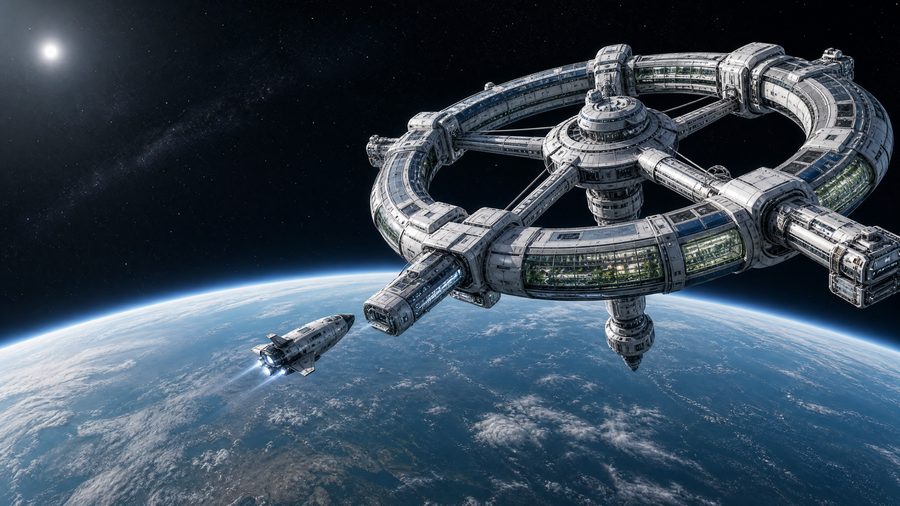
With no hidden information, the challenge becomes geometry and sequencing. Modules must physically connect, crew must walk between them in real time, and power runs along the same spine as traffic. A station that is numerically perfect can fail entirely because the greenhouse is nine modules from the galley and your crew spends their shift in transit.
What the second run exposed
- The spine is everything. Almost every failed station we built had a routing problem rather than a resource problem, and the game never once obscured that.
- Hull tolerance is a clock. It only ever decreases. Knowing this from minute one changes the entire opening, which is why the second run took thirteen hours less.
- Crew hours are the real currency. Power is easy to solve by hour six; the walking distances are what constrain you for the remaining twenty-five.
- Scenarios are genuinely different. The six starting scenarios change the station's shape rather than just its resource pool, so mastery does not transfer as cleanly as we expected.
Stress checks
The hardest scenario gives you a damaged spine and half the crew, and we cleared it on the fourth attempt in five hours. Notably it did not feel unfair at any point, because every failure was traceable to a decision we could name. That is the practical benefit of a transparent economy and it is worth more than any amount of tuning.
We ran a station to two hundred modules to test performance and the simulation slowed measurably past roughly one hundred and sixty, which is well beyond what any scenario requires but relevant if you intend to build freely. Save files were small and load times negligible. No crashes across three complete runs and roughly seventy hours total.
| Check | Result |
|---|---|
| Blind run | 31h, four scenarios completed |
| Second run | 18h, all six scenarios, timed |
| Hardest scenario | Cleared on attempt four, 5h |
| Scale test | Simulation slows past ~160 modules |
| Stability | No crashes in ~70h total |
The two real complaints
The tutorial scenario is twelve hours long. Not misleading, as in some games we have reviewed, but enormously overextended: it teaches everything correctly and then continues teaching for another eight hours after you have understood. Anyone who bounces off this game will bounce off there.
And the endgame stops asking questions. Once your spine is correct and your crew routing is solved, the remaining scenarios present variations rather than problems. We would have taken four scenarios with sharper constraints over six that eventually blur together, and the score reflects that the final third is the weakest.
The cold write-up
A week later the thing that stays is the absence of suspicion. At no point in seventy hours did we have to ask what the game was not telling us, and that turns out to be an enormous amount of cognitive space freed up for actual planning. Whether that is enough to carry a management game through its final third is the argument we had internally before settling on the score.