
Forty hours of pleasant work
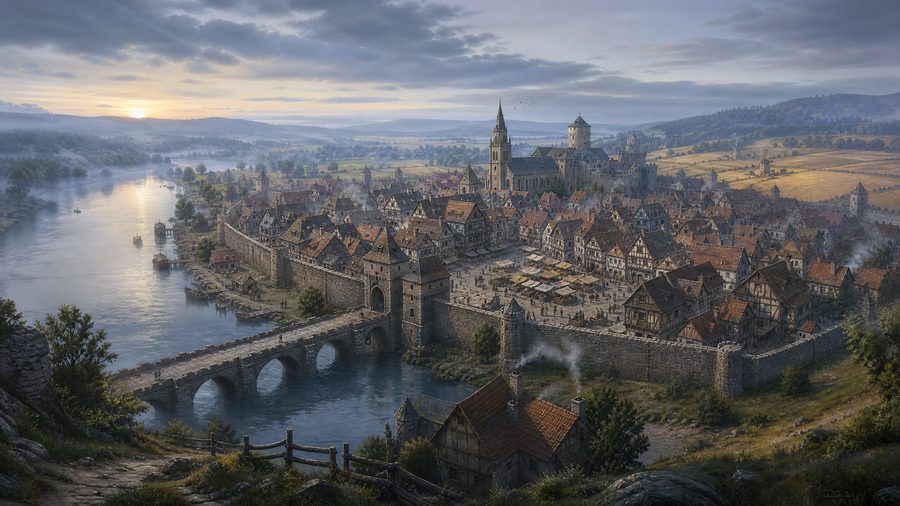
The blind run was genuinely enjoyable. Hollowmere Crossing is the best-looking city builder we have played this year: timber facades that fill in over seasons, a river that behaves believably, market squares that get busy at the right hours and empty at dusk. For forty hours we laid out streets, balanced grain against timber, watched the town grow across two river banks, and had a thoroughly agreeable time.
We also never failed. Not once. Not a famine, not a collapse, not a single winter that required a hard decision. At the time we attributed that to competence, which is the mistake the second run exists to catch.
The sabotage run
Our second pass was deliberately adversarial. We built the granary on the far side of the river from every field. We left the town without a well until population three hundred. We over-built housing by a factor of two and under-built every production chain that supports it. We ignored the seasonal warnings entirely.
The town prospered. Growth slowed by roughly fifteen percent and one district showed a decoration warning for two seasons. Nobody starved, nothing burned, no building was abandoned, and by hour twenty-two we had a larger settlement than our carefully-planned blind run had produced at the same point.
A builder in which the wrong answers and the right answers converge is not a strategy game. It is a very attractive diorama with a work schedule attached, and it should be reviewed as one.
Why the systems cannot bite
- Production has no failure state. Shortages reduce output rate rather than stopping it, so no chain ever actually breaks.
- Citizens do not leave. Unhappiness caps at a level that affects growth speed and nothing else, which removes the only real punishment a builder has.
- Distance is nearly free. Haulage time exists but is generous enough that layout barely matters, which is why our sabotage granary cost us almost nothing.
- Winter is cosmetic. Seasonal consumption rises by a small margin that any functioning town absorbs without planning.
What it does deserve credit for
The presentation is not a small achievement and we do not want to be dismissive about it. Buildings age. Roads wear where citizens actually walk. The river floods on a schedule you can observe and plan around even if you do not need to. There is an enormous amount of craft in this game, and for a certain kind of player — one who wants a calm, attractive space to arrange for forty hours — it delivers exactly that with no friction whatsoever.
Our objection is not that a low-pressure builder is illegitimate. It is that this one presents itself as a survival-oriented medieval settlement game, with famine warnings and seasonal alerts and a tutorial about grain reserves, none of which describes what actually happens when you play it badly.
| Check | Result |
|---|---|
| Blind run | 40h, zero failure events |
| Sabotage run | 22h of deliberate mismanagement, town still prospered |
| Hardest setting | Consumption +20%; no meaningful change in outcome |
| Scale test | Stable to ~1,200 citizens, slowdown beyond |
| Stability | Two crashes in 62h, both during fast-forward |
The cold write-up
A week later we remember the look of the market at dawn and none of our decisions, because none of them mattered. That is a precise summary of both the achievement and the problem. If the developers added genuine failure — citizens who leave, chains that break, a winter that can actually beat you — this would be an easy recommendation at a much higher number.
As it stands the score is for what it is rather than what it presents itself as: a beautiful, frictionless place to spend forty hours, sold with the vocabulary of a game that can be lost.