
What the blind run got wrong
For nineteen hours we played this game the way two decades of stealth titles have taught us to: hug the wall, wait for the patrol, move on the count, never be seen. It worked. We finished every mission, we were rarely caught, and the review we would have written from that pass alone would have scored it around 7.5 — a handsome, slightly slow game with good level architecture and not much personality.
That review would have been wrong, and the reason is a single mechanic we noticed on the blind run and completely misread. Guards in Nightfall Quarter have a suspicion state that does not escalate to alarm on its own. It decays. And it decays faster if you are visible and behaving normally than if you disappear.
The game is not asking you to be unseen. It is asking you to be unremarkable, which is a fundamentally different verb and one almost nothing else in the genre attempts.
The second run, at speed
Knowing that, the second pass took nine hours and played like a different game. We walked down lit streets. We stood in doorways while guards passed. Twice we followed a patrol at a distance of four metres for an entire corridor because moving with them registers as belonging. The missions we had spent forty minutes creeping through resolved in eight, and — this is the important part — they were more tense, not less, because being visible means every small mistake is immediately legible to everybody around you.
Four systems that only make sense on a second pass
- Decaying suspicion. Hiding preserves suspicion; behaving normally burns it off. The tutorial never says this and the interface never shows it.
- Patrol adoption. Walking in step with a patrol at the correct distance makes you effectively invisible to that group, which turns guards into transport.
- Lit-area confidence. Standing in light with no cover reduces attention faster than shadow does, inverting the genre's basic instinct.
- Noise as camouflage. Loud districts raise the threshold for what counts as suspicious, so the market at midday is safer than the alley behind it.
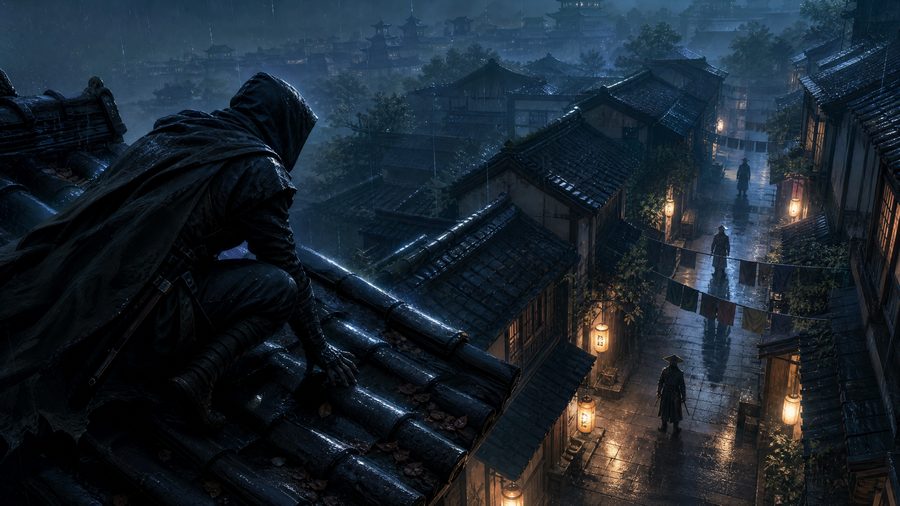
Stress checks
On the hardest setting, suspicion decays roughly forty percent slower, which sounds like it should punish the confident approach and instead punishes the timid one even harder. We cleared it in eleven hours using the second-run method and could not clear the third district at all using the crouching approach, which is a fairly emphatic confirmation of what the design wants.
On the low-specification machine the game held a stable frame rate at reduced settings with one exception: the rain-heavy fourth district dropped noticeably during the market scenes, and since the market is where the noise mechanic matters most, that is a genuine problem rather than a cosmetic one. Save files reached forty megabytes by the end and load times stayed under eight seconds throughout.
| Check | Result |
|---|---|
| Blind run | 19h, default difficulty, no guides consulted |
| Second run | 9h, full knowledge, timed per mission |
| Hardest setting | Cleared in 11h; timid play cannot clear district three |
| Low-spec machine | Stable except the rain market in district four |
| Save integrity | 40MB final file, loads under 8s, no corruption in 3 runs |
What is genuinely wrong with it
The tutorial actively teaches the losing strategy. Two hours of instruction on shadow, cover and patience, none of which is how the game is best played, and the mechanic that reverses all of it is never mentioned in any menu, tooltip or hint. We estimate a substantial number of players will finish this game the way we did on our blind run and conclude it is fine, which is a design failure of communication rather than of systems.
Second, there is no way to observe suspicion directly. The community has produced a chart. A game whose central innovation is a decay curve should be willing to show you the curve, even as an optional overlay.
The cold write-up
Seven days after finishing, what remains is the memory of walking through a guarded gate in plain sight while two soldiers argued beside it, and of understanding that the game had wanted me to do that since the first hour. Very few stealth games have a thesis. This one does, it is coherent, and it is buried under a tutorial that contradicts it.
The score reflects both facts: an excellent design, and a real risk that most players never find it.